Suzuka is Different
Every circuit has a personality. Suzuka's is unforgiving. The Esses demand total commitment from the first sector. Degner curves punish hesitation. 130R is still one of the fastest corners in motorsport, taken flat-out at the edge of what the car will physically allow. The S-shaped flow of Suzuka rewards smooth, consistent driving — not heroics.
What this means for prediction: overtaking opportunities are scarce. There's no equivalent of Albert Park's Turn 3 or Shanghai's heavy braking zone at Turn 14. If you qualify well at Suzuka, you tend to finish there. The circuit amplifies what qualifying already told you.
After Australia, qualifying told us: Mercedes has this regulation cycle figured out.
The Post-Australia Recalibration
The Japanese GP was the second race of the 2026 season, and every model component updated after Australia:
- Monte Carlo: Sprint-calibrated pace matrices from Albert Park race data replaced practice-session estimates
- Bayesian: Mercedes' prior updated with actual race-distance energy management evidence — they didn't just qualify fast, they managed the battery correctly over 58 laps
- XGBoost: Constructor strength rolling average shifted significantly after Race 1 results
The net effect: the Bayesian model's uncertainty widened for Red Bull and closed for Mercedes. The Mercedes 1-2 probability moved from a theoretical outcome to an expected one.
Qualifying Grid
| Pos | Driver | Team | Note | |:----|:-------|:-----|:-----| | P1 | Kimi Antonelli | Mercedes | First career pole — youngest ever | | P2 | George Russell | Mercedes | +0.082s | | P3 | Oscar Piastri | McLaren | — | | P4 | Charles Leclerc | Ferrari | — | | P5 | Lando Norris | McLaren | — | | P6 | Lewis Hamilton | Ferrari | — | | P14 | Max Verstappen | Red Bull | ERS mapping error in Q2 |
Antonelli's pole lap was extraordinary. At 19 years old, running his second season in Formula 1, he put together a Suzuka lap that beat his vastly more experienced teammate by 0.082 seconds. The circuit that rewards smoothness and commitment above all else — he delivered both.
Verstappen's P14 was the other story. An ERS mapping error in Q2 left him unable to deploy full power through the Esses, costing over a second per lap at a circuit that doesn't offer second chances. From P14 at Suzuka, the physics are even worse than P20 at Albert Park.
Ensemble Output
| Driver | Ensemble Win % | |:-------|:--------------:| | Antonelli | 55.7% | | Russell | 28.8% | | Piastri | 5.1% | | Leclerc | 3.8% | | Norris | 0.9% | | Hamilton | 0.8% | | Verstappen | 0.3% |
Mercedes 1-2 probability: ~84.5%
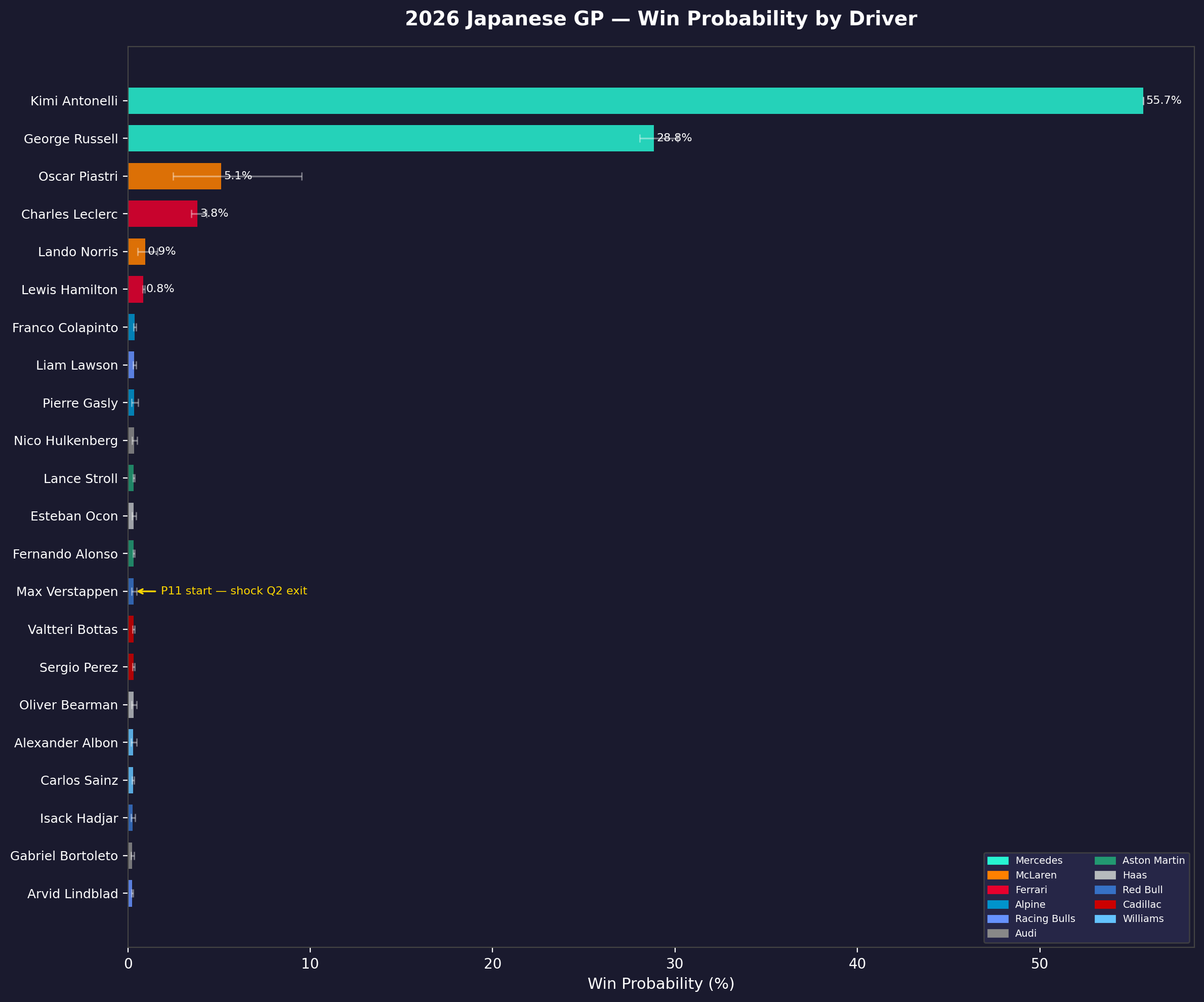
Antonelli is the model's clear favourite — not because of his career history, but because of what the physics say about a front-row pole at Suzuka combined with confirmed race-pace dominance from Australia. At a circuit with limited overtaking, P1 with the fastest car is an exceptionally strong position.
Why Antonelli Over Russell
The Bayesian model's prior for Russell is higher than Antonelli's (more historical wins, more regulation-change experience). But the Monte Carlo simulator doesn't care about history — it cares about qualifying pace and race-pace projections. Antonelli is 0.082s ahead on qualifying, and the circuit doesn't offer many opportunities to recover that gap if the cars are equal in race pace.
The result is a split: Russell's weight from historical prior versus Antonelli's weight from pole physics. The ensemble resolves this at 55.7% / 28.8%.
This is exactly what the ensemble is designed for: preventing any single worldview from dominating when the evidence is genuinely mixed.
Verstappen's Recovery Problem
From P14 at Suzuka, the model ran a specific recovery analysis across the 10,000 simulations.
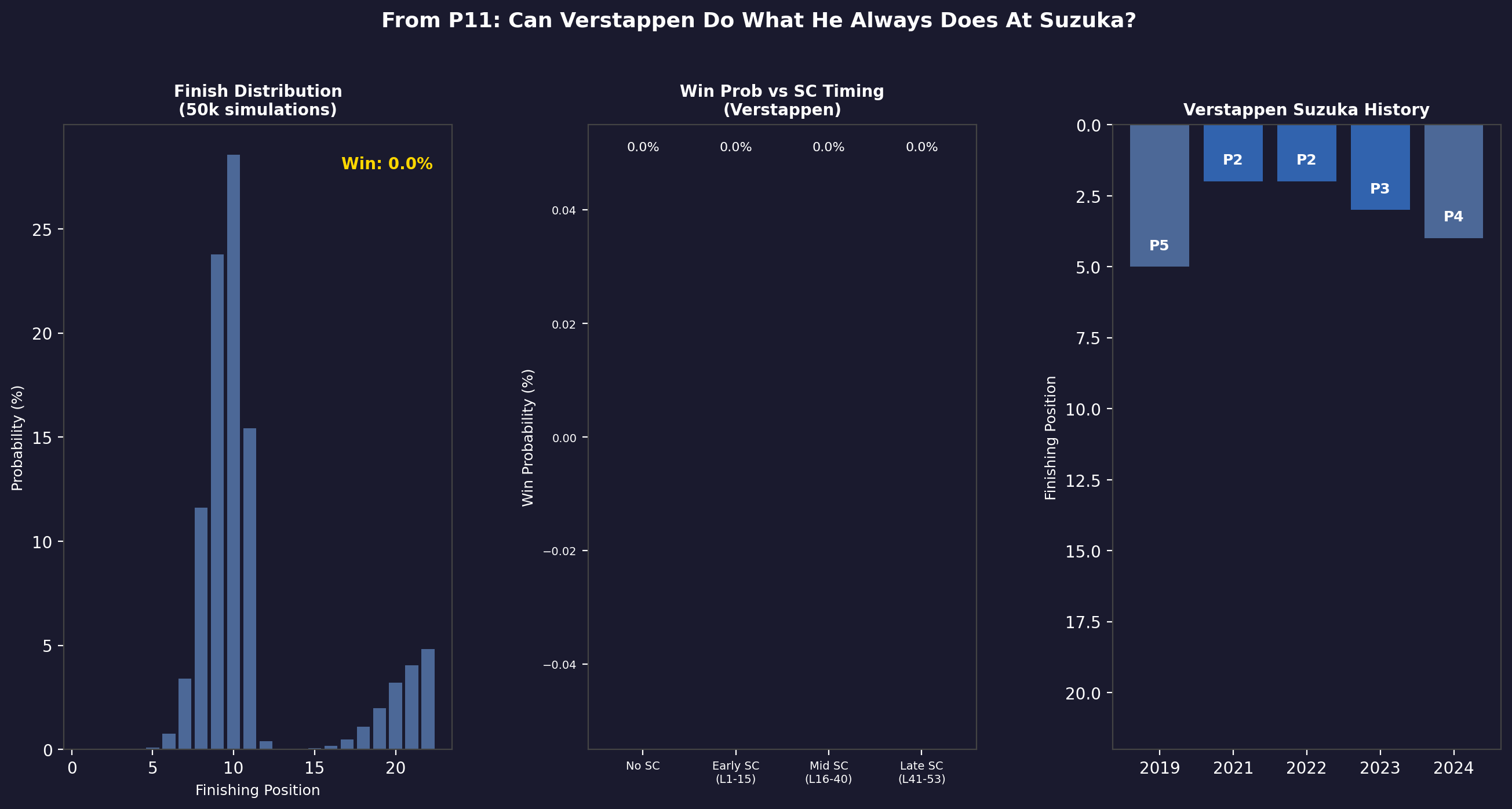
Base case win probability: 0.3%. With a late-race safety car on laps 41–53: ~2% maximum.
The mechanics of the problem: to win from P14 at Suzuka, Verstappen needs the 13 drivers ahead to either pit, DNF, or be compromised by safety car stacking. With Mercedes running 1-2 in dominant form, even a neutralisation event doesn't remove them from the equation — they'd still be ahead after any restart. The realistic outcome from P14 at Suzuka is a points finish in the top 8, which is what the model showed as his 35th-percentile scenario.
Model Agreement
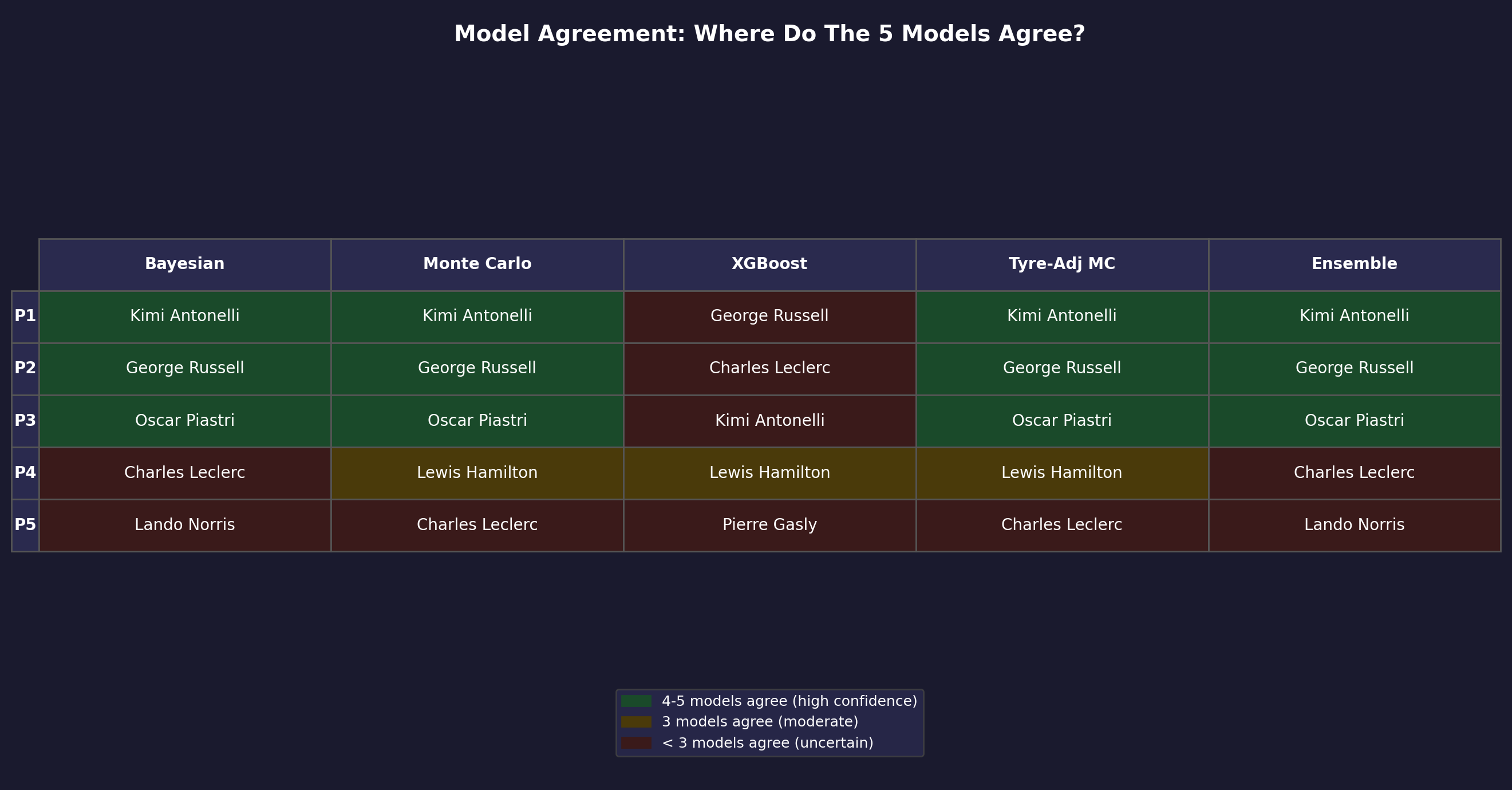
High-confidence zones at the Japanese GP:
- Mercedes 1-2: all three models agreed
- McLaren P3 (Piastri): XGBoost and Monte Carlo aligned, Bayesian slightly lower
- Verstappen sub-1%: Monte Carlo and XGBoost; Bayesian gave 1.2% (prior effect)
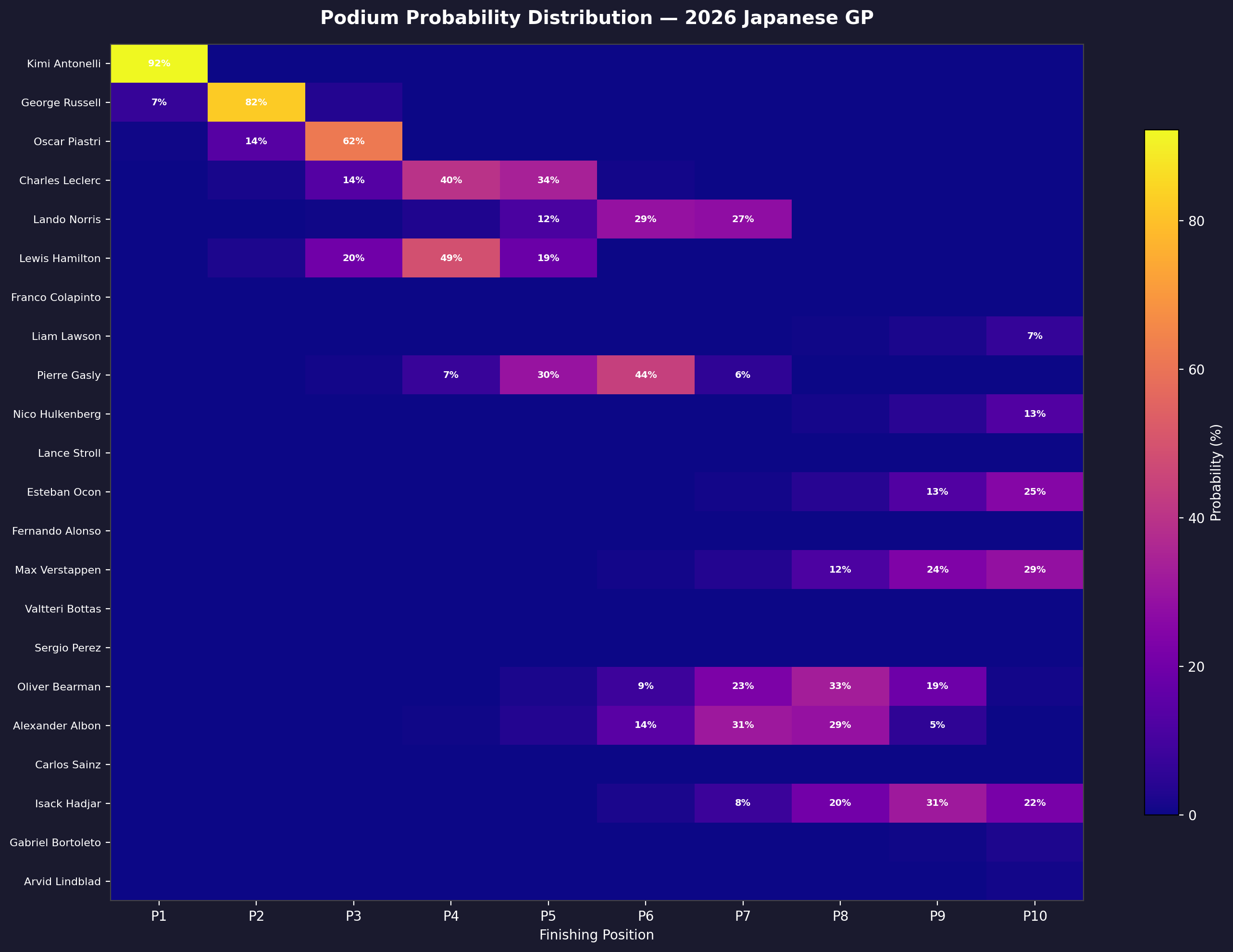
The podium heatmap showed the most concentrated probability distribution of the season so far — a sign that the model was operating with relatively low uncertainty, post-Australia calibration having tightened the variance significantly.
Tire Degradation at Suzuka
Suzuka's high-speed corners load the front tires differently from Albert Park's stop-start layout. The 2026 narrower compounds showed earlier degradation onset on the front-left — the tire that takes the most load through the Esses, 130R, and Spoon.
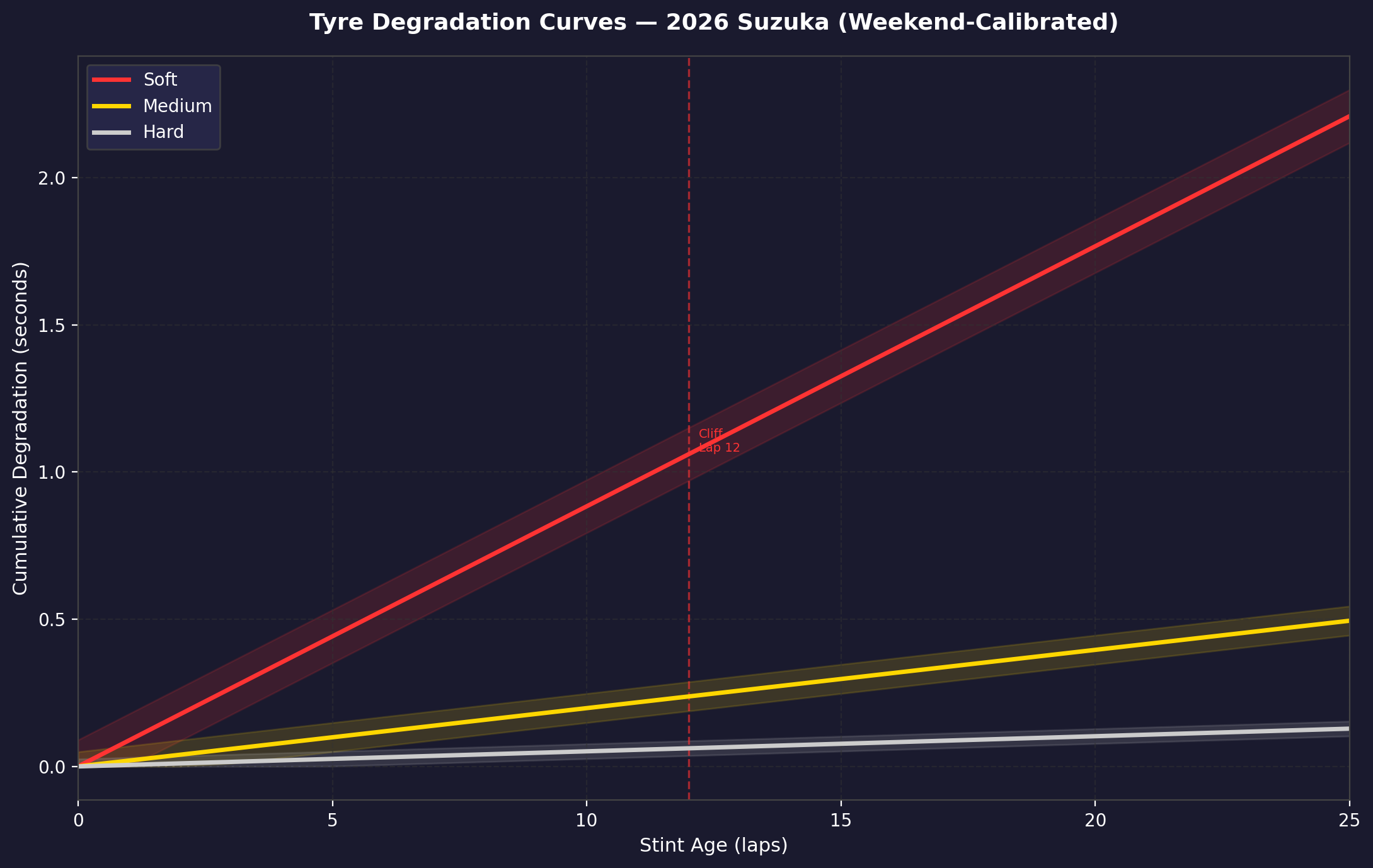
The practical effect: teams running one-stop strategies would face a decision on lap 20–24 about whether to extend the front-left into degradation cliff territory. Mercedes' simulator suggested they had enough pace to manage a longer first stint, which further advantaged their strategic position.
Bayesian Posteriors
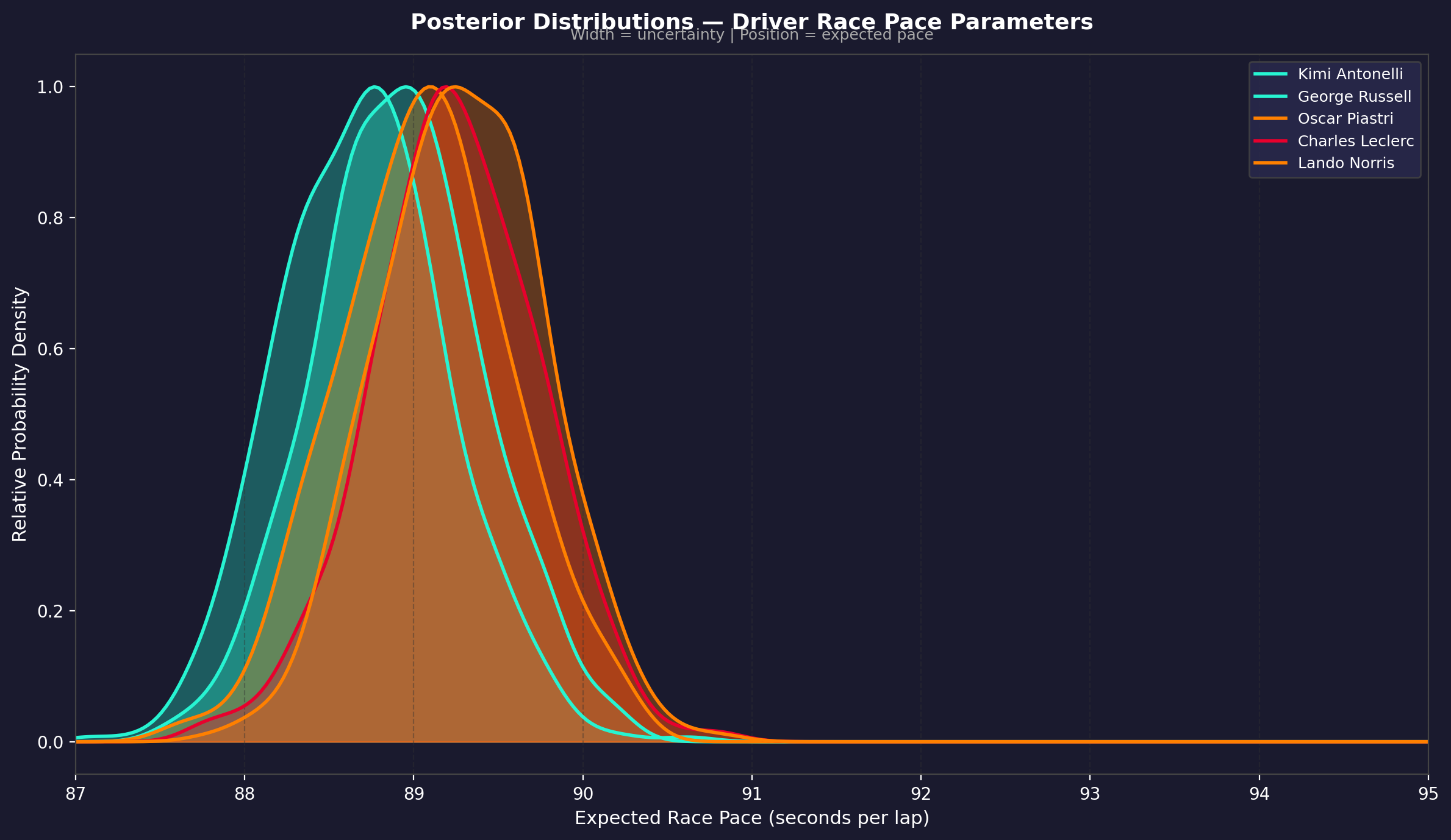
The Bayesian model's posterior distributions for the Japanese GP were notably tighter than Australia. The prior uncertainty from year-one regulations was still present, but two weeks of actual 2026 racing data — one qualifying session and one full race — provided strong likelihood updates that narrowed the distributions.
Hamilton's posterior remained elevated relative to his grid position (P6). Six Shanghai wins and strong regulation-change performance history kept his prior high enough to matter. The model wasn't predicting a Hamilton win, but it was refusing to dismiss him.
Technical Reports
Tech Stack
- Python: NumPy, SciPy, Pandas
- ML: XGBoost 2.0, Scikit-learn
- Data: FastF1, Jolpica-F1 API, OpenF1 API
- Visualization: Matplotlib, Seaborn
- Validation: Post-Australia calibrated pace matrices